Superjaws - a Comparison
| The new model
Superjaws (SJA200)
and the original model (SJA001)
have the same clamping mechanism
design, the same ability to apply
pressure of 1,000Kg (approx.
2240lbs.), the same reversible
clamping jaw and accessory jaws.
The purpose of this page is to point out, for those familiar with the original model, the structural design differences in the frame and the simpler method of preparing the unit for work. |
|
| Here are the Superjaws, folded down for storage or transport, the new SJA200 is on the left, the original SJA001 on the right. | 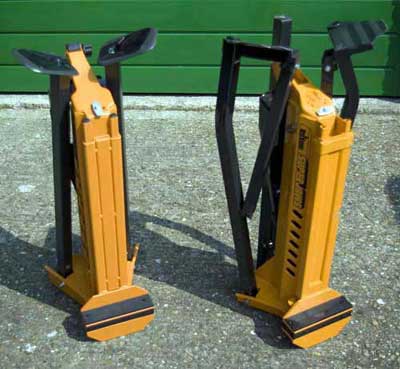 |
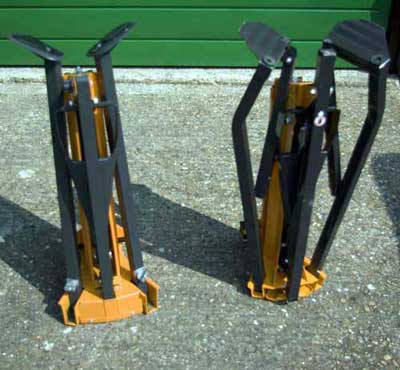 |
A rear view of the two models is shown here. The new version is 15Kg (33 lbs.) in weight, compared to the 18Kg (40 lbs.) of the original model. |
| Here, a view of the rear leg. To assemble, the turn-button must be sufficiently slackened, allowing the leg to be slid upward, out of its retaining square socket in the clamping assembly, as shown in the next picture. | 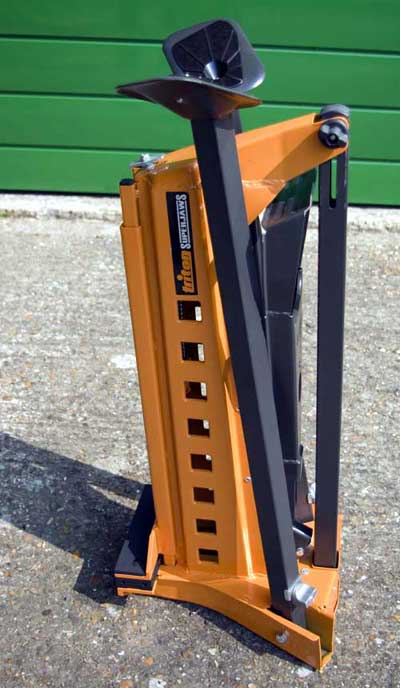 |
 |
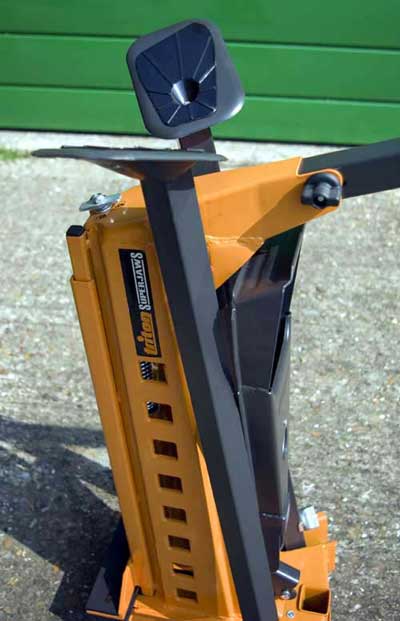
The rear leg, released from its retaining socket, can now be swivelled into position and then into the rear leg socket. |
| The rear leg has now entered the leg socket. It now needs pushing home and the retaining knob securing. |  |
 |
The rear leg shown fully home, ready for work. |
| The front legs are swung forward into position and held by locking knobs. This picture shows the left-hand leg locked to the clamp assembly, the right-hand locking knob still open for comparison. | 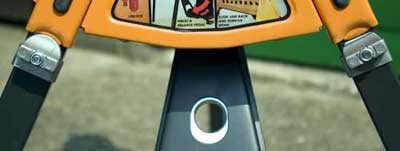 |
 |
The unit, ready for use. The "open tripod" configuration makes it easy to use on rough terrain. Clamping capacity is slightly increased to 956mm (37.5"). |
| Unlike the original model, the front plate of the clamping assembly is not pivoted, but it does contain the (red) clamping lock - shown here in the unlocked position. |  |
 |
Although the unit comes with a nine-page user manual, the main points are right in front of the user, on the front of the clamping assembly. |
| Here's the
clamping lock in the locked
position. The pedal is now pressed
to final gripping pressure.
To release the workpiece, the lock is slid upward. However, nothing happens until the pedal is pressed again, releasing the tension and un-clamping the workpiece. This is, in my opinion, a more "user-friendly" method than the original design. |
 |
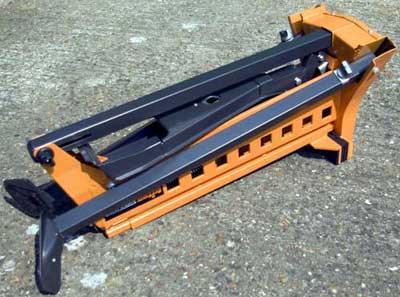 |
Here's another design improvement over the original model, as the rear leg acts as a carrying handle when folded for transport - much easier than bundling the whole thing in your arms. |

©Ray Girling, 2016 - 2026