 |
The Eden Project is, in one way, similar to the Grand Canyon - you cannot see it until you're through the entrance! The overview of the site is quite impressive, as can be seen here. It is becoming known as the "Eighth Wonder of the World," being the fourth most-popular paid-for visitor attraction in the UK. The two biomes are the largest "geodesic lean-to" conservatories in the world.
The Eden Project houses more than 135,000 plants of around 4,500 species. |
| This shot shows a closer view of the large sound stage, frequently used for concerts. It began life as a covered ice rink. | 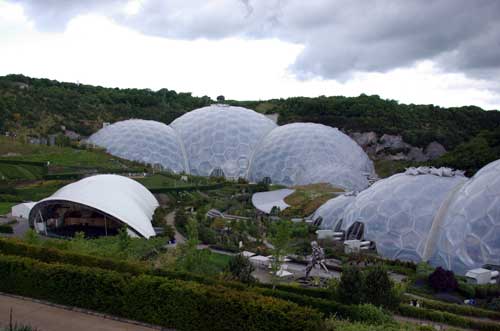 |
 |
A closer view of some of the ventilation in the Biomes, with a rear view of one of the many sculptures within the project. This is "WEEE MAN" by Paul Bonomini (Waste from Electrical and Electronic Equipment) The right leg circular objects are the drums from washing machines. Each of his teeth is a discarded computer mouse. |
| Another sculpture, with growing (grass) hair. Jean's in the shot to give an idea of the size of the artwork. | 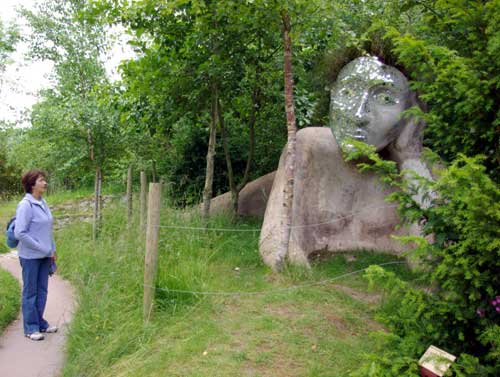 |
 |
A short distance from the reclining lady sculpture is a labyrinth, with a natural arbor cover. |
| Here is the "Industrial Plant" by Cornish sculptor David Kemp. | 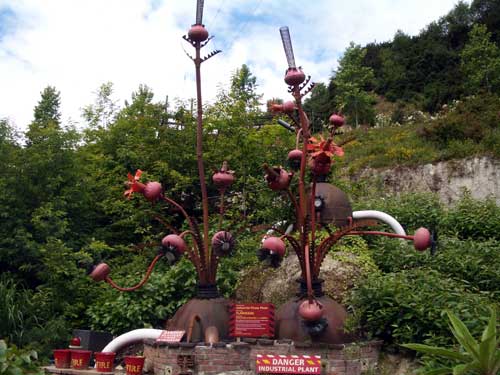 |
 |
Bombus the Bee - created by Robert Bradford. |
| One of the lavender slopes, soon to be in bloom again. |  |
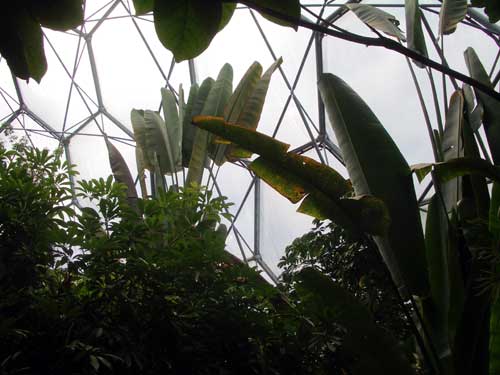 |
As soon as you enter the Rain Forest Biome, the heat and humidity strike you. The air is kept between 18°C and 35°C. This provides a range of environments that suit the tropical plants.
The size of these structures is difficult to convey, but they house some really enormous plants. |
| There is very natural-looking running water throughout the Biome - this shot is at ground level in the structure. |  |
 |
As you walk up the gently-sloping paths that wind through the plants, you get to see the previous waterfall from the top. |
| Now that the planting is properly established (opened to the public in 2000), it is very impressive in both variety and design. |  |
 |
As you continue upwards, so the falls become steeper and faster. |
| Some spectacular flowers are to be seen amongst the dense greenery.
Here's one example (a plantain): |
 |
 |
The "source" of the falls - very effective and natural, as well as cooling for the visitor after the climb. |
| Looking down from the high point of the path. |  |
 |
The Mediterreanean Biome was a sharp contrast to the Rain Forest Biome, as may be expected. Here's an overall view of this smaller structure. |
| The range and variety of plants are still amazing, as are some of the colours. |  |
 |
Artwork is to be found throughout this Biome too. This set depicts the story of wine-growing, showing Dionysus, the Greek God of the vines. |
| Not all of the colour and magnificence of the plants is under cover, as this wonderful outdoor display confirms. |  |
 |
The "Lost Gardens" of Heligan was the first major project of Tim Smit, CBE - the Chief Executive and co-founder of the Eden Project. Heligan is the most-visited private garden in the UK, with nearly 500,000 visitors each year. It has recently been voted the Nation's Favourite Garden. |
| The garden today has been returned to as near an original state as possible, so the massive neglect and overgrowth of vegetation can now only be seen in photographs on-site. This does not, however, at all detract from the huge variety and diversity of the plants. |  |
 |
There are, obviously, better times to visit gardens than others, but when we visited (mid-June) there were still some surprises. |
| A beautiful shade of blue - very striking in an otherwise plain setting. |  |
 |
Detail of one of the many thousands of foxgloves (Digitalis purpurea) that adorn the grounds. |
| On the 16th. of August, 2004, Boscastle, on the North coast of Cornwall, was the subject of a vigorous flash flood that came close to destroying the lower part of the village.
One of the outcomes of the flood was to deepen the river bed towards the outflow. |
 |
 |
The upper bridge can be seen in this picture. The lower bridge was jammed with debris during the flood, which worsend the overall effect. It was destroyed in the process and has now been replaced by a simpler structure. |
| The fishing harbour is now working again and - apart from the photographs in the Visitors' Centre - it is very difficult to spot any signs of the event.
Amazing work by all those involved in the restoration. |
 |
 |
This is the narrow mouth of the River Valency as it flows into the Celtic Sea (North Atlantic). A difficult navigation for a fishing boat in poor weather, it must have been a nightmare for anyone trying to return when the flash flood struck. |
| Our visit concluded at Mevagissey, an attractive port and working fishing harbour on the south Cornwall coast. |  |